How to Make It So People Cannot Tell if I Have Read Their Email in Gmail
Whether y'all're an upwardly-and-coming immature professional or a seasoned director, electronic mail writing is a vital aspect of business advice. And thanks to what's often seen as the mysteries of English grammar and the subtleties of the written discussion, it can be a daily struggle. That's especially true if you accept to motivate busy people to reply or accost a potentially touchy subject. To write a dandy email, you need to know ii things: common mistakes to avert, and next-level strategies to get ahead.
Just showtime things first—y'all have to know what a great email looks like if you're going to write one.
Hither'south a tip: Whether you're writing an e-mail, creating a presentation, or just sending a quick tweet, Grammarly can assist! Try Grammarly's app to brand your writing cleaner and more than impressive.
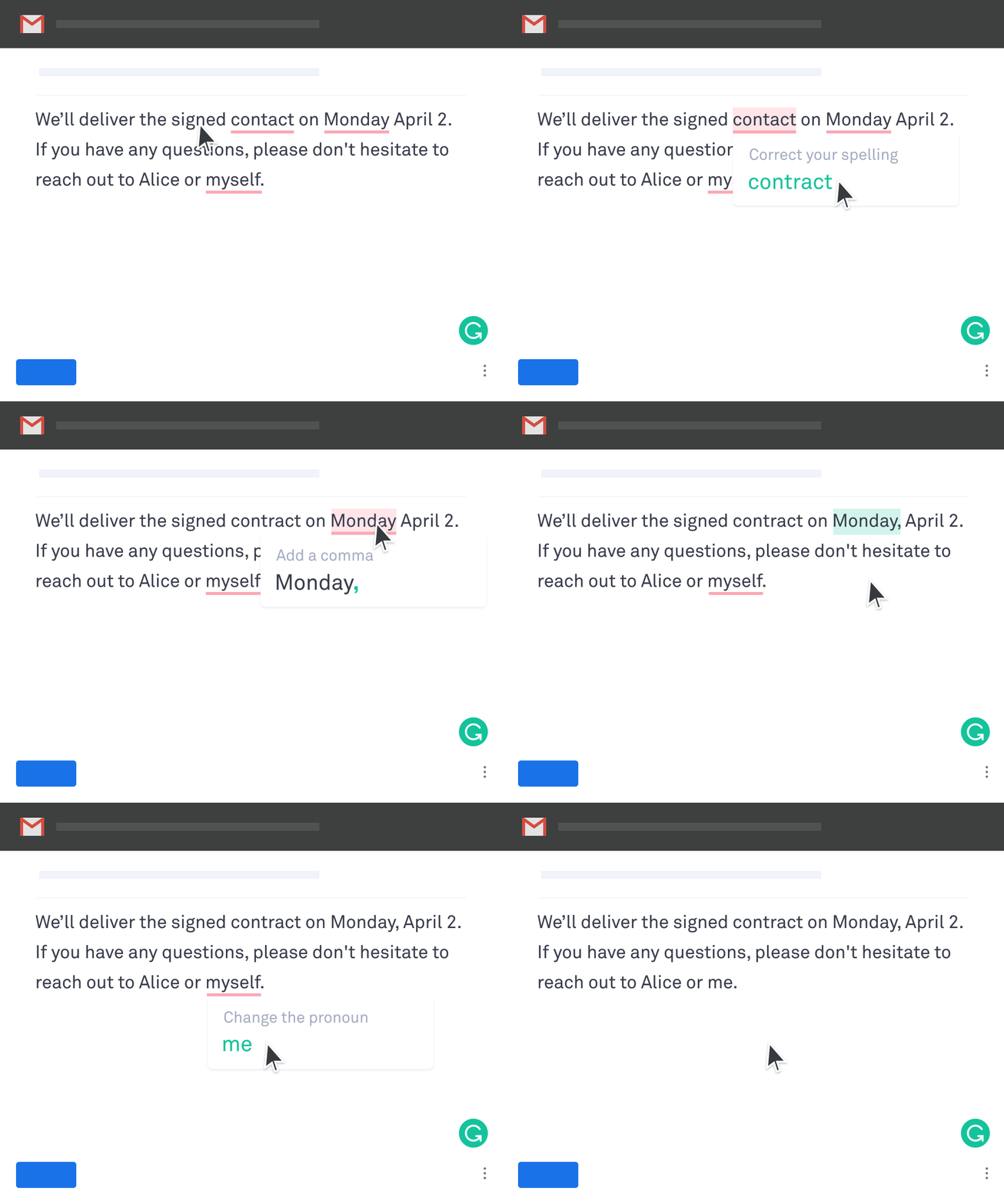
Anatomy of a good email
Every email y'all write has the same basic construction: Subject line, greeting, e-mail body, and endmost. But as with every written form of professional communication, in that location'south a correct way to exercise it and standards that should be followed. Here's how to write a proper email:
1 Subject line
The subject line could be the most important role of the email, though information technology'south oft overlooked in favor of the electronic mail torso. But if you're cold-emailing someone, or just establishing a professional relationship, your discipline line can entice people to open up the bulletin also as set expectations about what's enclosed. On the other hand, a poorly crafted or generic subject line (like "Hi" or "Y'all don't want to miss thos") tin deter the reader and event in your email landing in the spam folder.
"Spend double the amount of time crafting the right subject line as you do on the [trunk] because if they don't open the e-mail, information technology doesn't matter," says Cole Schafer, founder and copy principal of Love Re-create.
2 Openers
In nearly e-mail writing situations, you'll want to include a quick greeting to acknowledge the reader before diving into your principal message or request.
The exception: When you're on an email chain with close colleagues, it often becomes more natural to driblet the opener (as well as the closing). Though it may initially feel similar a faux pas, information technology signals a improve professional rapport.
3 Trunk
The trunk of an email is the meat of your message, and it must accept a clear and specific purpose, such as getting feedback on a presentation or arranging a coming together with a new client. It should as well exist concise. That style, people will be more inclined to read information technology, rather than skimming information technology and risking missing disquisitional information. If you tin can, boil it down to a few choice sentences.
And for emails that require more than length and item, keep it every bit focused as y'all tin. "Nobody wants to receive a novel. You want to keep it between 3, four, or 5 lines of text," says Schafer.
four Closings
Just as yous want to offset things off on the right foot with your greeting, you also want to part well. That ways writing a friendly sign-off. And there are plenty of options to choose from.
For instance, hither are 12 common, and professional, closings that Grammarly users chose on a given day:
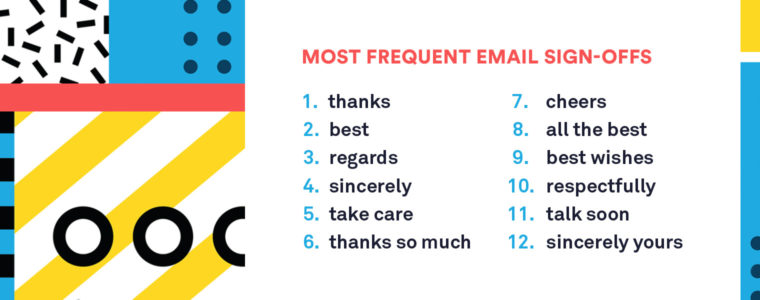
You'll desire to choose a closing that feels genuine to your personality and tailor it to the human relationship to ensure an appropriate level of professionalism. On the other hand, common closings like "honey," "sent from iphone," or "thx," may exist all-time left unused in professional emails.
You tin add any give-and-take to your Personal Dictionary.
Which words will you add? #cleanwritinghttps://t.co/itTRLCarol
— Grammarly (@Grammarly) September eighteen, 2018
Common email writing mistakes (and what to do instead)
Just as every email is an opportunity for professional growth, there's also the potential to autumn into common email writing bad habits. Here are eight mistakes to avoid:
1 Omitting necessary Oxford commas
The Oxford comma tin can be somewhat polarizing when thinking about how to write a proper email, depending on which style guide is utilized for professional communications in your industry —it'due south ordinarily either shunned or hailed as a tool for clarification. Either manner, a lot of people accept strong opinions almost it. Only leaving them out can lead to defoliation, depending on the judgement.
Just like a good for you marriage, AP style calls for clear communication. We also believe in the value of compromise. So as a reminder, the Stylebook doesn't prohibit all Oxford commas. If omitting a comma could lead to defoliation or misinterpretation, then employ the comma. https://t.co/vGsuRrwpQW
— AP Stylebook (@APStylebook) Baronial fifteen, 2018
What to practice instead: While the Oxford comma may not be suitable in certain contexts, it's usually a skilful idea to use them in emails. That'due south because it can help you relieve time and avert miscommunication, confusion, and fifty-fifty legal trouble.
ii Hedging
Grammarly users know that when it comes to hedging, it's ameliorate to omit information technology than leave it in, especially in emails. And if you lot're worried well-nigh coming off equally boorish, don't be: Contrary to pop belief, hedging language makes you sound less confident, which can ultimately undermine your writing.
What to practise instead: State your idea or stance, then explain the "why" behind your reasoning. That way, yous'll be better understood and your brilliance can smooth through.
3 Extremely long and/or unclear copy
Would y'all read an email that was one,000 words long? Probably not—most people skim emails that are on the long side. And if you lot add hard-to-follow sentences or mixed messages, to your draft, you're even less likely to become a satisfactory response. (Or any response.)
"I get a ton of [emails] that are simply these huge blocks of text. And I understand why they practice that—and so you have plenty detail. Just it's actually difficult to read and I'grand non going to read the whole affair," says Kat Boogaard, a Wisconsin-based freelance writer.
What to do instead: Keep information technology concise and focus on the matter at hand. Then end with a call to activeness, a requested response engagement, and brand it clear that you lot're open to questions and follow-ups (if that'south the example).
iv Being besides casual (or formal)
Depending on your circumstances, wavering also much to the coincidental or formal side of writing can be a misstep. Being overly casual is often seen as a rookie mistake, simply stiff, formal language tin can also exist detrimental to your message.
What to exercise instead: In hitting the perfect balance between formal and coincidental, the central is thinking near the relationship between yourself and the recipient and have social cues as your communication progresses.
"Yous kind of want to see what someone else is doing and participate, play along, sort of acknowledge the way communication develops and the way expectations in a human relationship develop," says Dan Post Senning, an etiquette expert at the Emily Mail service Found.
5 Cliches
Not all e-mail cliches are cardinal sins. Certain aspects of your emails are bound to be a footling formulaic. After all, most emails take the same bones structure, and at that place are phrases that you lot may use to ensure clarity or comprehend your bases. But if y'all're going to repeat phrases, brand sure they have a clear purpose.
As Kiera Wright-Ruiz, a social media managing director at Google's Local Guides puts it, "Even though I always repeat, 'please let me know if you lot have any questions,' I really do desire to know if they have questions."
However, about of the time, yous'll want to edit out cliches whenever possible since they tin can make people tune out. Here are the top seven to avoid:
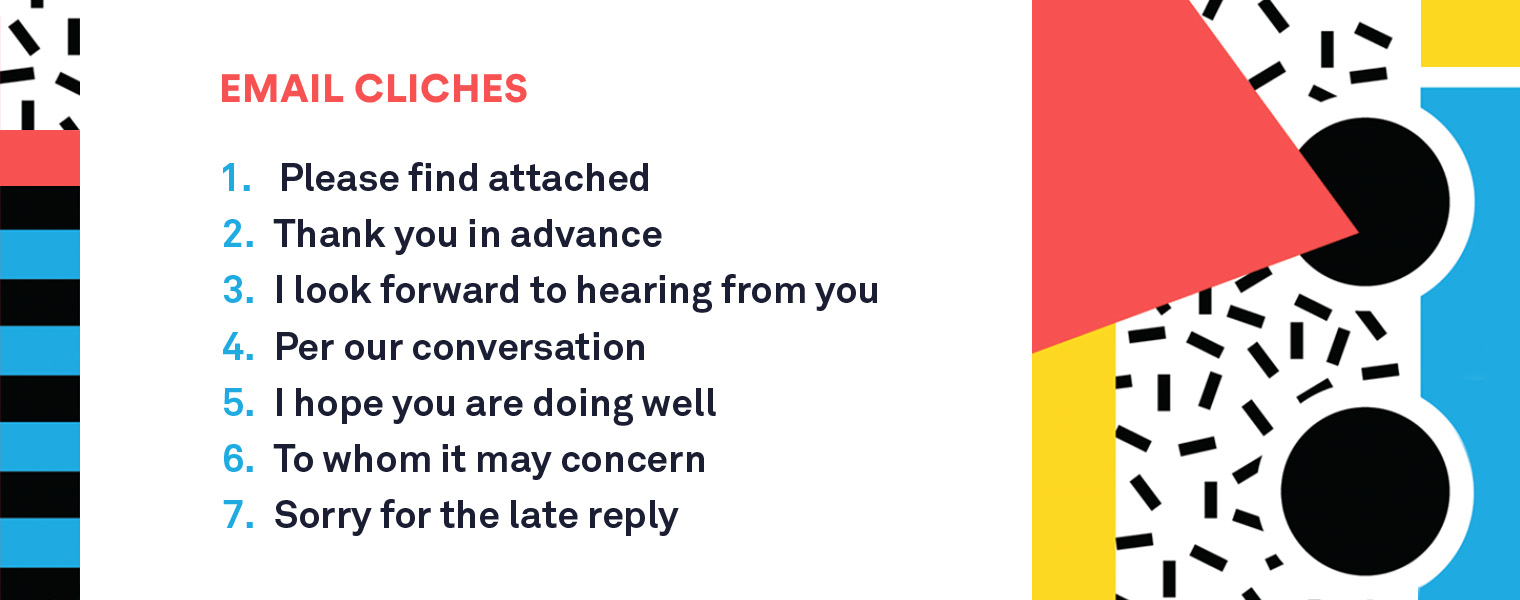
Method: Nosotros searched for terms used by Grammarly users based on our virtually popular blog articles.
What to do instead: Try reading the draft for cliches, tone, and voice to more effectively communicate your message while keeping the reader engaged. Ask yourself: If your boss (or mom) read this email, would y'all be happy with information technology? If the answer is yeah, and then you're on the right rail.
6 Repetition
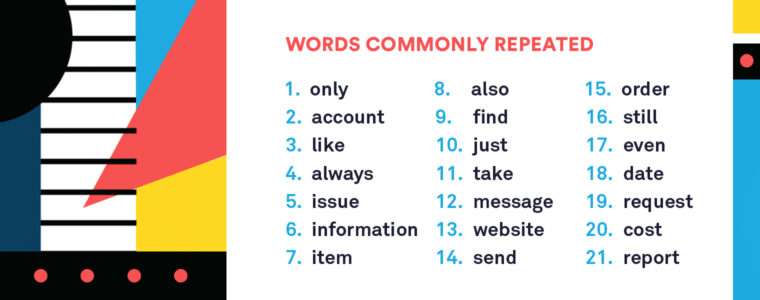
People frequently repeat words within the same paragraph, twice in ii sentences, or just as well shut together to go unnoticed. While it's not the worst criminal offense, it's another matter that can make a reader melody out.
Here are the virtually commonly repeated words to avert:
What to do instead: Endeavor reading your draft out loud, using the text-to-speech function on your phone, or running information technology by a colleague before sending it off. Grammarly can also assistance you lot grab these repeated or overused words.
seven Robotic language
Electronic mail may be a descendant of snail mail, simply that doesn't mean your messages should sound like an old-timey version of yourself. In fact, emails should sound like the person who is writing it. So using phrases that audio like something out of a Victorian novel isn't the all-time move if you want to connect with the reader.
"Allow's face information technology: Nobody wants to read a college textbook. You desire to read a weblog or an article or a real chat. They're a person, they're not a robot. And then use language that sounds like something you would say if y'all're just sitting in a coffee shop," says copy chief Schafer.
What to do instead: You tin can get a more natural effect by pretending you're writing to a friend or having a conversation with a friendly acquaintance. For example, you lot probably wouldn't say something like, "Greetings" and "I promise the weather is fair where you are" if you were meeting someone for java. You'd say something like, "Hi" and "Thank you again for your time."
8 Overuse of exclamation points!
Enthusiasm is great. Just in certain contexts, the overuse of exclamation points can practise more harm than good. This is particularly true if yous're forging a new human relationship or contacting someone exterior of your company. Yous are, afterwards all, a representative of your piece of work when yous utilize a company email accost. But people love exclamation points, and they're still something that many people rely on to convey a positive tone.
For case, here are the almost common sentences and words people employ with assertion points in emails:
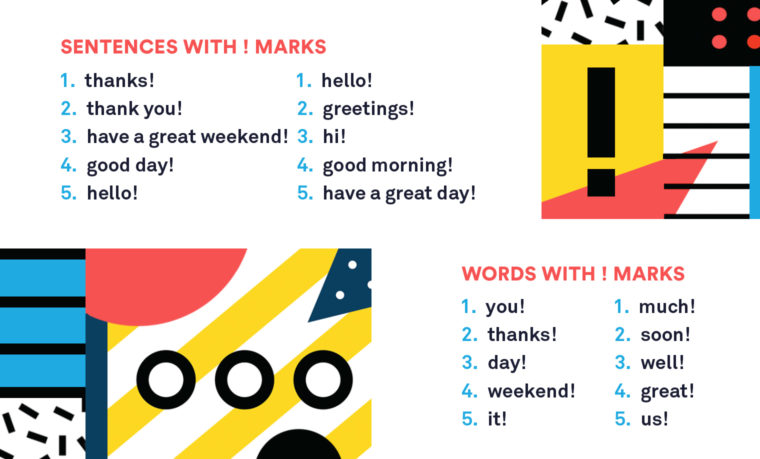
What to do instead: Subsequently you've written your draft, practise a quick search for exclamation points and utilize your judgment to determine which (if any) to keep based on your relationship with the recipient. As a general rule, attempt to keep it to one or two per e-mail with colleagues.
We're feeling grateful today.
Grateful that a content superstar like @MarketingProfs uses Grammarly. #fridayfeeling #ourherohttps://t.co/rrLpgheikv
— Grammarly (@Grammarly) September 28, 2018
Next-level email writing moves
Once yous've got the proper email format and yous know what mistakes to avoid, it'southward time to focus on making your drafts stand up out from the myriad emails virtually people get every day. Here are four strategies to take yours to the next level:
Think positive
Sending an email that is remotely negative, or fifty-fifty neutral, can put y'all in a tricky place. And every bit with any written communication, in that location may exist room for misinterpretation.
"In the absence of other information, our interpretation often defaults to the negative," explains communication-etiquette expert Post Senning. "When you're talking most negative communication, you're [missing] the information that is tone of voice, the twinkle in your centre, the skilful sense of humor that you intend something with or even the 18-carat care or concern with which you lot're offer critique. And so be really careful. When something reads as negative to you, information technology probably comes across as even more negative to someone else."
Strike the right tone
Y'all wouldn't want to get an email that reads, "Dear [client]," or which references your work in public relations when you're actually in sales, considering it would immediately evidence that the sender is either mass emailing you, or they didn't practice the proper research and detect the correct contact. Similarly, y'all'll want to make certain that every electronic mail you send has a tone that'southward crafted specifically for the recipient, and that you're sending information technology to the correct person.
So even though information technology may exist tempting to use templates, information technology's important to personalize it and keep in listen the communication mode of the recipient before hitting send. To achieve this, a quick Google search or a peek at the recipient'due south LinkedIn or Twitter feed can do wonders.
Before sending, try putting yourself in the recipient's shoes for a gut-bank check on tone and content. And if you accept a hard time reading your ain tone in electronic mail, Grammarly'south tone detector can assistance you determine how y'all sound to your recipient.
Follow upwardly—in good time
If you're sending an email, you're likely looking for a timely response. But with the big amounts of emails nearly people sort through each twenty-four hours, things can finish up getting lost. Every bit a general rule, a follow-up message should never come less than mean solar day after sending the initial e-mail.
In other words: Don't be the person who sends a follow-upward request ii hours after sending. In extreme cases, that kind of behavior can fifty-fifty become you blocked. "When you're taking more time and really caring about the person on the other side of the e-mail, you're immediately going to see a much college response rate. I had to learn that the hard way," says copy chief Schafer.
Go far easy on the eyes
Most of the messages you send volition probable be on the shorter side, which is corking for rapid responses and getting things done. Just for longer emails, scannability is the name of the game. That's when things like bolded font, bullet points, underlined sentences, and a TL;DR (likewise long, didn't read) department come in handy.
In that location are a lot of factors to go along in mind when composing an email, and there's a wide margin of mistake. But later all is said and done, information technology isn't about perfection. It'southward about effective communication.
"I think people feel this pressure that you need to exist this perfect communicator with this huge vocabulary and these perfectly structured sentences. And I don't know that that's always the case because you're just 2 people, communicating," says freelance author Boogaard.
More from Grammarly:
- How Does Grammarly Work?
- How Grammarly Helps Yous Acquire
- Meet Grammarly's Tone Detector
![]()

Source: https://www.grammarly.com/blog/email-writing-tips/

Post a Comment for "How to Make It So People Cannot Tell if I Have Read Their Email in Gmail"